Old-Fashioned Egg Custard Pie
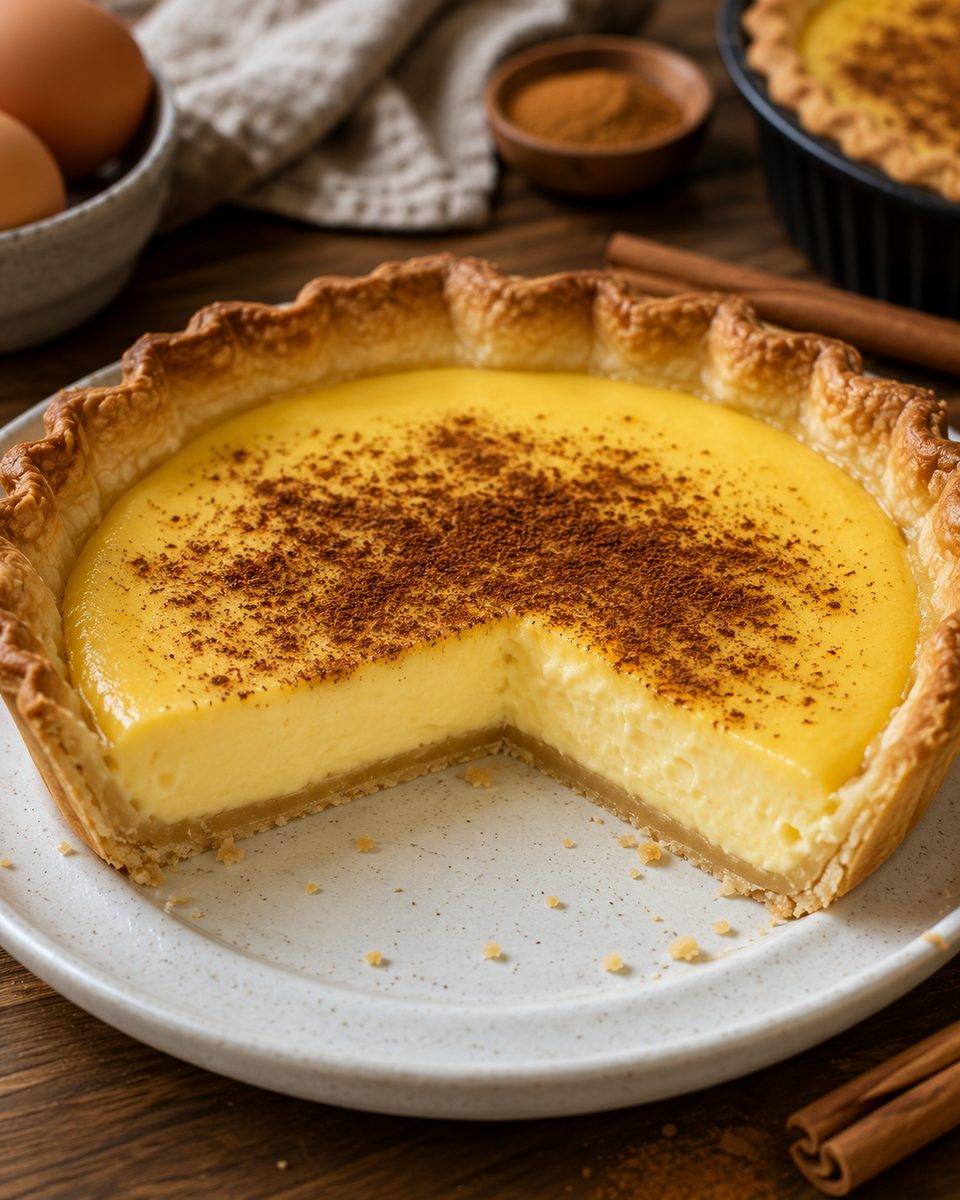
Egg custard pie is what a farm kitchen made when the hens were laying and the larder held little else — eggs, milk, sugar and a good grating of nutmeg, baked gently in a pastry shell until it barely holds itself together. Our granny just called it "egg pie" and made one most Sundays; it sat cooling on the sideboard through lunch, and the nutmeg smell reached the garden gate. It is the plainest pie there is, and somehow the one everybody asks for.
Two things stand between you and a silky slice. First, scald the milk — heat it until it steams and just shivers at the edges before whisking it into the eggs. Warm milk means the custard starts cooking the moment it goes in, so the crust spends less time under wet filling. Second, take the pie out while the centre still wobbles. Custard carries on cooking in its own heat; wait for the middle to firm up in the oven and you've already gone too far — overbaked custard turns grainy and weeps watery puddles. The classic failure, and entirely avoidable.
The rest is quiet patience: a partial blind bake so the bottom stays crisp, a low oven, and a proper cool on the rack — a good three hours — so the slices come away clean and glossy. Plain ingredients, gentle handling, and a pie that tastes of another era.
Old-Fashioned Egg Custard Pie
Silky baked custard, crisp pastry and plenty of nutmeg — baked low and slow so it never weeps.
Ingredients
- 175 g plain flour, plus a pinch of salt (for the pastry)
- 85 g cold butter, cubed, plus 2–3 tbsp ice-cold water
- 4 large eggs
- 100 g caster sugar and ¼ tsp fine salt
- 500 ml whole milk
- 1 tsp vanilla extract and a whole nutmeg, for grating
Method
- Pastry. Rub the butter into the flour and pinch of salt until it looks like breadcrumbs, add just enough ice-cold water to bring it together, then chill 30 minutes. Roll out and line a deep 23 cm pie tin; prick the base and chill again while the oven heats.
- Blind-bake. Oven to 200°C (fan 180°C / gas 6). Line the pastry with paper and baking beans; bake 15 minutes, then remove the beans and bake 5 more, until the base looks dry. Lightly beat one of the filling eggs, brush the inside with a thin coat and give it 2 minutes more to seal — the rest of that egg goes into the custard. Turn the oven down to 160°C (fan 140°C / gas 3).
- Scald. Heat the milk until it steams and tiny bubbles gather at the edge — hot, but never boiling.
- Whisk. Gently whisk the eggs, caster sugar and ¼ tsp salt — no froth — then whisk in the hot milk in a slow stream. Add the vanilla and strain through a sieve into a jug.
- Fill and bake. Set the warm crust on the pulled-out oven shelf, pour in the custard there, and grate nutmeg generously over the top. Bake 35–45 minutes, until the edges are set but the centre — a circle the size of your palm — still wobbles like set jelly.
- Cool. Cool completely on a rack, about 3 hours — it finishes setting as it cools. Slice with a knife dipped in hot water and wiped between cuts.
Any custard that won't quite fit the shell goes into a buttered teacup and bakes alongside the pie — the cook's own little pudding, ready a good ten minutes before everyone else's.
Tips for a silky, no-weep custard
Scald the milk first
Milk heated until it steams — never boils — means the custard sets faster and silkier, and the crust spends less time under wet filling.
Low oven, early exit
160°C, and out while the centre still wobbles. Custard finishes cooking in its own heat; a firm middle in the oven means grainy, weeping slices later.
Cool before you cut
A full 3 hours on the rack. Warm custard won't hold a slice — patience is what makes the pieces come away clean and glossy.
Questions, answered
Why is my egg custard pie watery or weeping?
Almost always overbaking. When custard climbs past about 80°C the egg proteins tighten and squeeze out their moisture, so the filling turns grainy and leaks watery puddles (bakers call it weeping). Bake low at 160°C, take the pie out while the centre still wobbles — about 75°C in the middle — and let it finish setting as it cools. Cutting it while warm will also make it weep.
How do I know when egg custard pie is done?
Use the wobble test: nudge the tin after 35 minutes. The outer 5 cm should be set, while a palm-sized circle in the centre still sways like set jelly — not liquid, not firm. A knife tip inserted 3 cm from the edge should come out clean, and a thermometer in the centre reads 74–77°C. If the whole pie is firm in the oven, it is already overbaked.
What is the difference between egg custard pie and a custard tart or flan?
They are the same family, set differently. A British custard tart is shallower, usually enriched with cream and baked in a tart tin. A flan or crème caramel has no pastry at all — the custard bakes in a caramel-lined mould and is turned out. Old-fashioned egg custard pie is the deep American version: a plain milk-and-egg custard baked in a pie shell with nutmeg on top.
Can I make egg custard pie ahead, and how should I store it?
Yes — it is actually best made a day ahead, once fully cooled. Because it is an egg pie it must live in the fridge, loosely covered, where it keeps for 3 days; never leave it out overnight. Eat it within 48 hours if you want the crust at its crispest, and serve cool or at room temperature. Do not freeze it — thawed custard separates and weeps.