Old-Fashioned French Toast
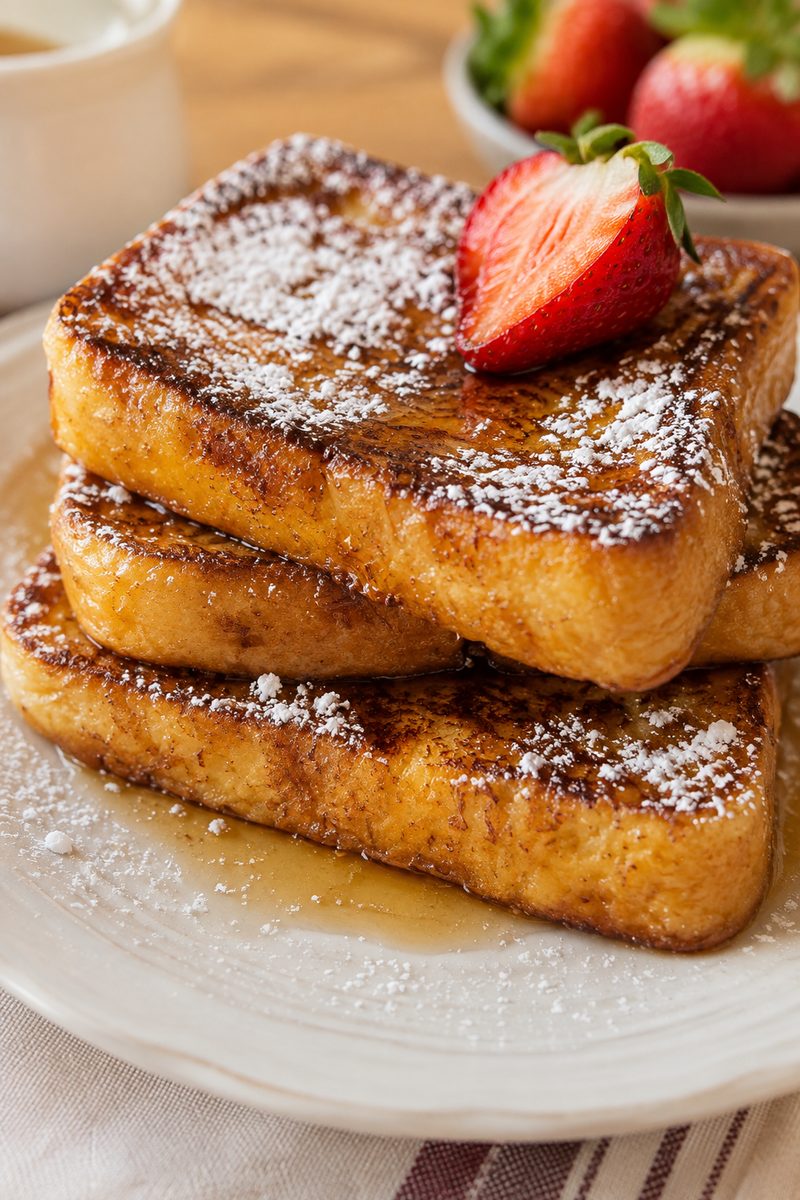

French toast was never a recipe so much as a way of rescuing bread that had gone past its best. That is the whole origin of the dish, and it is still the key to making it well: fresh, soft bread is the wrong bread. It collapses in the custard and steams in the pan. Bread that has dried out for a day drinks the custard up and holds its shape while it cooks.
The second thing granny knew is that French toast is a custard dish, not an omelet. The ratio matters. Too many eggs and it tastes eggy and turns rubbery at the edges; too much milk and it never sets and goes soggy in the middle. One egg to about a quarter cup of dairy, with a spoon of sugar and real vanilla, gives you something that cooks into a soft set rather than scrambling on the surface.
And it is cooked in butter, over medium-low heat, with patience. High heat browns the outside long before the custard in the center has set — that is the classic failure, a slice that looks perfect and runs when you cut it. Lower heat, a little longer, and you get a burnished crust and a creamy middle that holds.
Old-Fashioned French Toast
Thick slices of day-old bread soaked in a real egg custard and cooked slowly in butter — crisp at the edge, set all the way through, and never eggy.
Tap + or − to scale every ingredient
Ingredients
Tick each one off as you go.
- 8 slices day-old bread, cut 2 cm thick
- 4 large eggs
- 1 cup (240 ml) whole milk
- ¼ cup (60 ml) heavy cream
- ⅛ cup (25 g) granulated sugar
- 2 teaspoons vanilla extract
- 1 teaspoon ground cinnamon
- 1/4 teaspoon freshly grated nutmeg
- Pinch of salt
- 3 tablespoons (45 g) butter, for the skillet
- Maple syrup and confectioners' sugar, to serve
Method
- Dry the bread. Use bread that is a day old and cut it a good 2 cm thick. If all you have is a fresh loaf, lay the slices on a rack in a 300°F (150°C) oven for 8 to 10 minutes to dry them out. Thin, fresh slices are the reason most French toast turns to mush — they have no structure to survive the soak.
- Make the custard. Whisk the eggs first, on their own, until they are completely uniform with no ropes of white left. Then whisk in the milk, cream, sugar, vanilla, cinnamon, nutmeg and salt. Beating the eggs alone first is what stops you finding cooked strands of white on the finished slice.
- Soak, do not dunk. Pour the custard into a wide dish and lay the slices in for about 20 seconds a side, pressing gently so they take it up evenly. Sturdy bread like brioche or challah can take 30 seconds. You want the custard right through to the middle but the slice still holding together when you lift it.
- Heat the skillet properly. Melt a knob of the butter in a heavy skillet over medium-low heat. It should foam gently and smell nutty, not sizzle hard or brown instantly. If the butter browns the moment it hits the pan, the pan is too hot and the custard will not have time to set.
- Cook it slowly. Lay in the slices without crowding and cook for 3 to 4 minutes a side, until deeply golden and slightly puffed. Resist moving them around. Add fresh butter between batches and wipe out any burnt solids, or the later slices will taste scorched.
- Check the middle. Press the center of a slice with a fingertip — it should feel springy and set, not squashy. If it still gives, the outsides are done but the custard is not, so lower the heat and give it another minute a side rather than turning the heat up.
- Hold them properly. Keep finished slices on a rack in a 250°F (120°C) oven while you cook the rest. On a plate they steam underneath and lose the crust you just worked for; on a rack the air circulates and they stay crisp.
- Serve. Dust with confectioners' sugar and pour over warm maple syrup. Warming the syrup takes ten seconds and stops it chilling the toast the moment it lands.
If you are cooking for a crowd, soak and cook the slices in batches rather than leaving them all sitting in the custard. Bread left to soak while you cook the first pan turns to paste by the time you get to it.
Tips for French toast that is never soggy
Use bread with a crumb
Brioche and challah are the classics because the enriched dough holds up to a soak, but a sturdy white sandwich loaf left out overnight does an honest job. Avoid anything thin-sliced or airy — there is nothing there to hold the custard.
Whisk the eggs alone first
Egg white is stringy and stubborn, and it will not disperse properly once you have added milk. Thirty seconds of whisking before any dairy goes in is the difference between a smooth custard and white ribbons cooked onto the surface of your toast.
Butter, not oil, but keep it clean
Butter is what gives the crust its flavor and color, but the milk solids in it burn over repeated batches. Wipe the pan between rounds and add fresh butter each time so the last slices taste as good as the first.
Questions, answered
Why is my French toast soggy in the middle?
The heat was too high. The outside browns and looks finished long before the custard in the center has had time to set, so you take it out and find it wet inside. Cook over medium-low heat for 3 to 4 minutes a side and press the middle with a fingertip before you call it done — it should feel springy, not squashy. Bread cut too thin or too fresh makes it worse.
What is the best bread for French toast?
Day-old brioche or challah cut about 2 cm thick. The enriched dough is sturdy enough to soak without falling apart and rich enough to taste like more than a vehicle for syrup. A plain white sandwich loaf left out overnight also works well.
How long should you soak French toast?
About 20 seconds a side for most bread, up to 30 for something dense like challah. You want it saturated through but still firm enough to lift in one piece. Long soaking is what turns the middle to paste.
Can you make French toast ahead of time?
You can mix the custard the night before and keep it covered in the refrigerator. Cooked slices reheat well on a rack in a 350°F (180°C) oven for 5 to 8 minutes, which crisps them back up far better than a microwave, and they freeze in a single layer for up to a month.
Why does my French toast taste eggy?
Too many eggs for the amount of dairy. The ratio you want is roughly one egg to a quarter cup of milk and cream, plus sugar and vanilla to season it. That gives a soft custard rather than something closer to a flat omelet.
From Granny's Pantry
The know-how behind this recipe: